Best TOPIK Apps in 2026: Vocabulary, Past Papers, and Mock Tests Compared
Quick summary: no single app covers every part of TOPIK. Vocabulary is the foundation for passing TOPIK I and II, so build your stack around a vocabulary app plus past-exam practice, then add a mock-test or writing tool for your weak areas. Before choosing, check two things first: is the data from an official dictionary, and is it based on real past exams? Those two decide whether what you memorize actually shows up on test day. Below we compare 5 popular options by content, data source, and real US prices.
Quick comparison
| App | Core focus | Content | Data source | Interface / explanations | Price model (US) | Last updated |
|---|---|---|---|---|---|---|
| TOPIK Note | Vocabulary SRS + past-exam reading | 9,000+ words (levels 1–6), 870+ past-exam reading questions (20 real exams) | Official dictionary of the National Institute of Korean Language (krdict) | English (interface + answer explanations) | One-time purchase or subscription | Aug 2026 |
| Migii TOPIK | Mock tests + AI essay grading | TOPIK/EPS past and mock exams, AI writing feedback | Official past exams + self-made mock questions | English, some screens in Korean | Free + subscriptions (many tiers) | Aug 2026 |
| TOPIK - 한국어능력시험 | All-in-one practice (free tier) | Listening/reading/writing practice, 6,000+ word list, mock tests | Self-made lists and questions (source not disclosed) | English | Free + IAP ($4.99/mo, $29.99/yr, $49.99 one-time) | Jun 2026 |
| Anki | General-purpose SRS cards | Self-built or shared decks, quality varies | User-made | Depends on the deck | Desktop/Android free, iOS one-time | Sep 2025 (iOS) |
| Duolingo | Daily habit, general Korean | Gamified general Korean course — no TOPIK alignment | Own curriculum | English | Free + Super ($9.99–12.99/mo) | Aug 2026 |
Note: prices, plans, and update status change over time — always check the store page. This table and the prices below were compiled from US App Store pages in August 2026; "Last updated" is the most recent version date shown in each app's version history at that time. All five run on iOS and Android (Anki also has a desktop version).
5 things to check before you choose
The table columns aren't random — when picking a TOPIK app, check these five in order:
- Data source — this decides translation quality. Is it an official dictionary, or a self-made word list (or machine translation)? Memorize a wrong definition and you lose points directly on test day.
- Level mapping — can you study only the words your target level needs? A word list that mixes level-5 words into your level-2 goal wastes your time.
- Quiz formats — just flip-cards, or multiple question types? Memory is built on active recall; reading without testing doesn't stick.
- Past exams and explanation language — can you drill real past questions inside the app, and can you actually understand the explanations? Checking answers without reading explanations won't improve your reading score.
- Price model — subscription or one-time? Compare by total cost over your prep period (3 months to a year), not the monthly sticker. Especially for vocabulary: rather than juggling several word books and apps, pick one trustworthy source and finish it — scattering your progress and review history across tools costs more to rebuild than it saves.
App by app
TOPIK Note — vocabulary + past-exam reading in one place
Best for: building from official data, from vocabulary all the way to past-exam reading (levels 1–6)
TOPIK Note's core difference is the data source: every definition, pronunciation, and example sentence comes from the Basic Korean Dictionary (krdict) of the National Institute of Korean Language, curated by a native-Korean team — not a machine-translated word list. It covers:
- 9,000+ words sorted by TOPIK level (1–6)
- 4 quiz types (Korean→meaning, meaning→Korean, fill-in-the-blank, sentence reading) — not just flip-cards
- SRS review scheduling based on the forgetting curve
- 20 real past exams, 870+ reading questions with English explanations
- Fully usable offline
Word order isn't alphabetical either — it follows how often words actually appear in past exams. Our analysis of 20 past papers found that the 1,000 most frequent words cover 98.6% of TOPIK I reading passages (full data in this analysis). Studying the most-tested words first is the highest-ROI order.
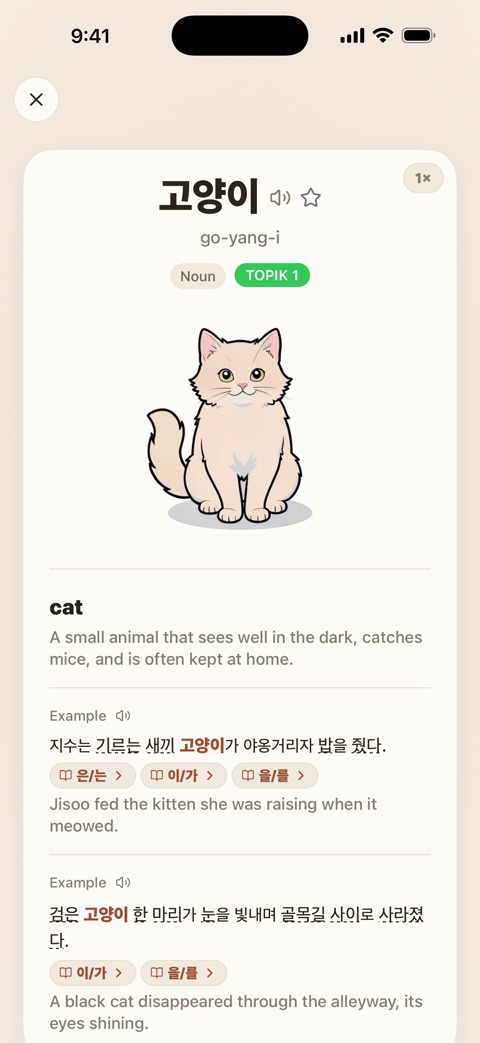
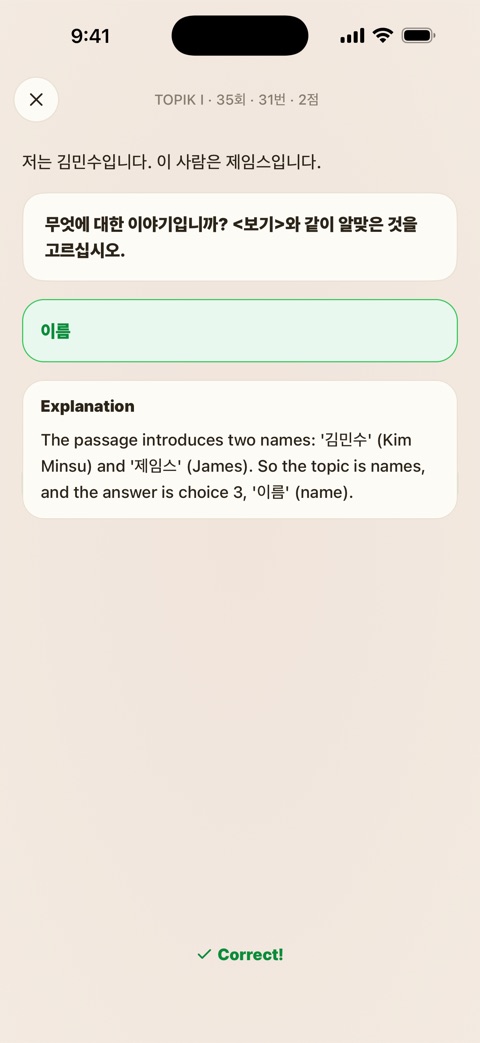
Price (US): premium is $10.99/month, $64.99/year, or a $79.99 one-time purchase (pay once, keep forever). If your prep runs longer than half a year — or you want to keep your Korean after the test — the one-time option means no subscription clock.
Weak points: no full timed mock-test mode, and no writing feedback. For TOPIK II 쓰기 you'll need another tool or a human grader.
Migii TOPIK — mock exams and AI essay grading
Best for: test-format practice once your vocabulary is in place (especially TOPIK II)
Migii plays a different position than vocabulary apps — it's an exam simulator. Four real strengths:
- Full timed mock tests for TOPIK I/II and EPS-TOPIK, with a score and level prediction at the end
- Real past official questions, with listening, reading, and writing drills by section
- AI feedback on writing — the only app of the five that grades 쓰기, and the main reason TOPIK II candidates use it
- Personalized study plans and progress tracking
Two things to know. First, most core features unlock only with a subscription — the free tier is limited. Second, the US plans come in many tiers (practice packages $14.99–59.99, Premium $32.99/$44.99), so read carefully what each one unlocks and for how long. Some screens also still show in Korean.
TOPIK - 한국어능력시험 — the popular free all-in-one
Best for: a zero-cost starting point to feel out the exam format
A widely downloaded freemium app covering listening, reading, writing, vocabulary (a 6,000+ word list), and mock tests, with an English interface. As a free way to get familiar with question formats, it's a reasonable first stop — and its paid tier ($4.99/mo, $29.99/yr, or $49.99 one-time) is cheap.
The trade-off sits exactly at check #1: the word lists and mock questions are self-made, and the store page doesn't disclose their source. If a definition or a mock question drifts from how the real exam words things, you won't know until test day. Fine as a supplement; risky as your single source of truth.
Anki — maximum freedom, maximum overhead
Best for: experienced Anki users who want a fully custom word bank
A general-purpose SRS tool with a mature algorithm and unlimited flexibility. For TOPIK specifically, three real costs:
- Decks are on you: shared TOPIK decks vary wildly — wrong definitions and unmarked levels are common. Vetting, fixing, and maintaining them is your time
- No question types: flip-cards by default; active-recall quiz formats mean building templates yourself
- iOS costs money: desktop and AnkiDroid (Android) are free, but AnkiMobile on iPhone is a $24.99 one-time purchase
Anki works best as a second-stage tool: build your base with a ready-made TOPIK app, then export your own weak words into a deck for fine-tuning.
Duolingo — a great habit, not a TOPIK plan
Best for: building a daily Korean habit before (or alongside) exam prep
Duolingo's Korean course is excellent at what it's designed for: making you show up every day. But it isn't aligned to TOPIK — no level-mapped vocabulary, no past-exam questions, no exam-format reading practice. Super Duolingo runs $9.99–12.99/month in the US, which over a 6-month prep window costs more than most dedicated TOPIK tools while covering the least exam-relevant ground. Keep it for streaks and fundamentals; don't count it as exam prep.
What your prep actually costs (US, 6-month example)
Using check #5, here's the total for a 6-month prep window (all prices from US App Store pages, August 2026):
| Plan | 6-month total | Notes |
|---|---|---|
| TOPIK Note monthly | $10.99 × 6 = $65.94 | Cheapest only for sprints of ~5 months or less |
| TOPIK Note yearly | $64.99 | Covers 12 months — beats monthly from ~6 months |
| TOPIK Note one-time | $79.99 | Beats monthly past ~7 months, yearly from year two — yours forever |
| Migii practice/premium tiers | $14.99–59.99 (per plan) | Check what each tier unlocks and its duration |
| TOPIK - 한국어능력시험 yearly | $29.99 | Cheapest paid all-in-one; self-made content |
| AnkiMobile (iOS) | $24.99 | One-time; deck quality and upkeep are extra |
| Super Duolingo | $9.99–12.99 × 6 ≈ $60–78 | No TOPIK alignment |
Two common stacks, priced:
- TOPIK I self-study: one solid vocabulary + past-exam app covers it — a $79.99 one-time purchase (or $64.99/year) and you're fully equipped.
- TOPIK II sprint: TOPIK Note (vocabulary + reading) + Migii (mock tests + 쓰기 feedback) — roughly $80 + one Migii tier. Still far below a single term of academy classes, if you actually follow the schedule.
Which stack for which level
- Target TOPIK I (levels 1–2): one main app is enough. Want official-dictionary data plus past-exam reading, pick TOPIK Note; want a zero-cost format-familiarizer first, start with the free TOPIK app and upgrade when definitions start to matter. Build reading stamina with real past papers in the last month.
- Target TOPIK II (levels 3–4): TOPIK Note (intermediate vocabulary + past-exam reading) + Migii (timed mocks). For 쓰기, use Migii's AI feedback or a human grader.
- Target advanced (levels 5–6): TOPIK Note advanced words + repeated past papers + heavy reading of news and long-form text. At this level the bottleneck is rarely the app — it's reading volume.
Whatever your level, the order is the same: vocabulary → reading → mock tests. Grinding mock tests on a thin vocabulary base plateaus fast. (How many words each level actually needs: see the level-target table here.)
FAQ
QHow many words do I need for TOPIK?
Common targets are roughly 1,500–2,000 words for TOPIK I and 4,000–6,000+ for TOPIK II mid-to-high levels. A level-sorted word list keeps you from memorizing outside your target range. From our analysis of 20 past exams: the 1,000 most frequent words cover 98.6% of TOPIK I reading passages.
QCan I pass TOPIK with just Duolingo?
Not realistically. Duolingo builds general Korean and a daily habit, but has no TOPIK-level word mapping, no past-exam questions, and no exam-format practice. Use it as a habit layer; do your actual prep with exam-aligned tools.
QTOPIK Note or Migii — which one?
They do different jobs: TOPIK Note handles vocabulary and past-exam reading (official dictionary data), Migii handles timed mocks and AI writing feedback. For TOPIK I one vocabulary-centered app is usually enough; for TOPIK II with 쓰기 worries, the two together are the most complete stack.
QAre free apps enough?
For getting started, yes — the free TOPIK app plus the official past papers on topik.go.kr can carry early TOPIK I prep. For intermediate levels and up, free tiers usually run out of depth (word range, question banks, explanations), and the time you lose to unverified definitions costs more than the paid tools.
QCan I study offline?
Depends on the app. TOPIK Note stores all words and past-exam questions on-device, so it works fully on the subway or a plane. If commute time is your main study window, check offline support first.
QWho makes TOPIK Note?
A native-Korean team. The vocabulary data comes from the official dictionary of the National Institute of Korean Language (CC BY-SA 2.0 KR license).
Written by the TOPIK Note team. We build one of the apps compared above, so we've kept the comparison factual — every app's strengths are listed as they are, prices are from US App Store pages as of August 2026, and the right pick depends on your level and weak areas.