How Many Words Do You Need to Pass TOPIK? Targets by Level, Backed by Past-Exam Data
Quick summary: The common targets are roughly 1,500–2,000 words for TOPIK I (Levels 1–2), about 4,000 for Levels 3–4, and 6,000+ for Levels 5–6. But which words you learn matters more than how many: our analysis of 20 past exams shows the top 1,000 most frequent words cover 98.6% of TOPIK I reading passages. This article covers the targets, the data, and a 90-day plan to get there.
Vocabulary targets by level
| Level | Exam | Target vocabulary | What it feels like |
|---|---|---|---|
| Level 1 | TOPIK I | ~800 words | Greetings, numbers, daily basics |
| Level 2 | TOPIK I | ~1,500–2,000 words | Most everyday conversation |
| Level 3 | TOPIK II | ~3,000 words | Familiar social topics |
| Level 4 | TOPIK II | ~4,000–5,000 words | Following news headlines |
| Level 5 | TOPIK II | ~6,000 words | Abstract and specialized texts |
| Level 6 | TOPIK II | 6,000+ words | Academic and current-affairs texts |
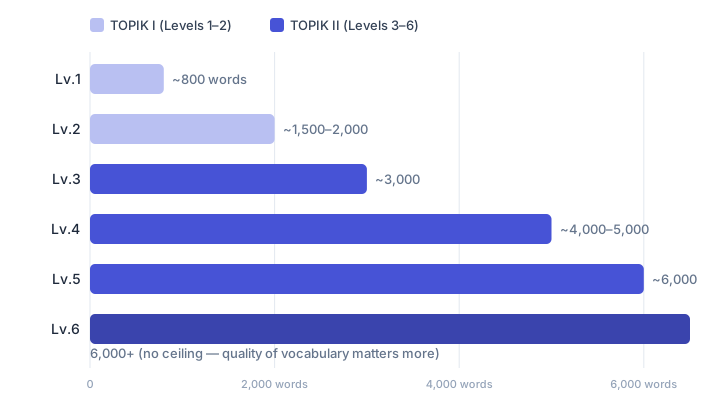
These estimates are based on the National Institute of Korean Language's learner vocabulary lists and widely used exam-prep guidelines.
What actually appears on the exam is far more concentrated
We ran a morpheme analysis on the reading passages of 20 past exams — 878 reading questions, 682 unique passages, about 21,000 content words. The skew in exam vocabulary is dramatic:
| Top N words by frequency | TOPIK I passage coverage | TOPIK II passage coverage |
|---|---|---|
| Top 100 | 47.6% | 27.1% |
| Top 500 | 86.2% | 55.1% |
| Top 1,000 | 98.6% | 70.9% |
| Top 2,000 | 100% | 87.3% |
- The 1,000 most frequent words cover 98.6% of TOPIK I reading passages. Even the top 500 cover 86% — for beginners, nailing the 500 most frequent words unlocks most of the reading section.
- For TOPIK II, the top 1,000 cover 71% and the top 2,000 cover 87%. Vocabulary breadth expands sharply at the intermediate level, which is exactly where a level-sorted, frequency-ordered list pays off.
- 28 recurring words appeared in 18 or more of the 20 exams (사람 person, 회사 company, 사용 use, 받다 to receive, and so on). Starting with these is the shortest route.
Methodology: passages only (instructions and answer choices excluded), content words only (particles and endings excluded), morpheme-analyzed; "top N" means frequency rank within this past-exam corpus. Passages shared by multiple questions are counted once.
In short: learning in dictionary or textbook order is the slow way. Level-sorted, frequency-first is the data-backed shortcut.
The 40 words that appear most in TOPIK I reading (real data)
This list isn't "words you should know" copied from a textbook. It's a direct count over the TOPIK I reading passages of 20 real past exams: Count is how many times the word appears, Exams is how many exams it shows up in (out of the 10 TOPIK I papers in our corpus). A word that appears in nearly every exam is one you will almost certainly meet on test day.
Meanings come from the Basic Korean Dictionary (krdict) of the National Institute of Korean Language, checked against how each word is used in those passages.
| # | Word | Level | Meaning | Count | Exams |
|---|---|---|---|---|---|
| 1 | 있다 | 1 | be, exist | 161 | 10/10 |
| 2 | 하다 | 1 | do, perform | 148 | 10/10 |
| 3 | 가다 | 1 | go, head for, be bound for | 83 | 10/10 |
| 4 | 친구 | 1 | friend | 79 | 10/10 |
| 5 | 사람 | 1 | person | 78 | 10/10 |
| 6 | 좋다 | 1 | good, great, excellent | 65 | 10/10 |
| 7 | 보다 | 1 | see, look at, notice | 59 | 10/10 |
| 8 | 오다 | 1 | come | 52 | 10/10 |
| 9 | 되다 | 1 | become, turn | 43 | 10/10 |
| 10 | 만들다 | 1 | make, create, produce | 41 | 10/10 |
| 11 | 먹다 | 1 | eat, have, consume | 39 | 9/10 |
| 12 | 한국 | 1 | Korea | 37 | 9/10 |
| 13 | 사다 | 1 | buy, purchase, get | 36 | 10/10 |
| 14 | 많다 | 1 | plentiful, many, a lot of | 35 | 10/10 |
| 15 | 좋아하다 | 1 | like | 33 | 9/10 |
| 16 | 쓰다 | 1 | write | 32 | 10/10 |
| 17 | 아이 | 1 | child, kid | 31 | 6/10 |
| 18 | 없다 | 1 | not exist, not have | 30 | 10/10 |
| 19 | 회사 | 2 | company, corporation | 24 | 10/10 |
| 20 | 시간 | 1 | time | 24 | 6/10 |
| 21 | 다니다 | 1 | attend, commute | 24 | 8/10 |
| 22 | 여행 | 1 | travel, trip | 23 | 7/10 |
| 23 | 요즘 | 1 | nowadays, these days | 22 | 10/10 |
| 24 | 타다 | 1 | ride, get on, board | 22 | 8/10 |
| 25 | 학교 | 1 | school | 21 | 8/10 |
| 26 | 공연 | 2 | performance, show | 21 | 8/10 |
| 27 | 사용 | 1 | use, usage | 20 | 7/10 |
| 28 | 학생 | 1 | student, learner | 20 | 6/10 |
| 29 | 맛있다 | 1 | tasty, delicious | 19 | 9/10 |
| 30 | 다음 | 1 | next, following | 19 | 7/10 |
| 31 | 주말 | 1 | weekend | 19 | 10/10 |
| 32 | 지금 | 1 | now | 19 | 8/10 |
| 33 | 노래 | 1 | song, music, singing | 19 | 7/10 |
| 34 | 재미있다 | 1 | interesting | 19 | 9/10 |
| 35 | 오늘 | 1 | today | 19 | 8/10 |
| 36 | 아버지 | 1 | father, male parent | 19 | 6/10 |
| 37 | 운동 | 1 | exercise | 18 | 8/10 |
| 38 | 가게 | 1 | shop, store | 18 | 7/10 |
| 39 | 만나다 | 1 | meet with, encounter, come across | 17 | 9/10 |
| 40 | 그림 | 1 | drawing, painting, sketch | 17 | 9/10 |
How to read this table
- The "Exams" column matters more than "Count." A word appearing 20 times in only 3 exams may just reflect one passage dwelling on that topic. A word at 10/10 is one that shows up year after year.
- Almost all of them are Level 1 words. That matches the coverage data above: TOPIK I reading is built on a small core vocabulary that repeats heavily. If these 40 aren't solid yet, drilling past papers is out of order.
- These are only the first 40. The top 500 covers 86% and the top 1,000 covers 98.6% of TOPIK I reading — the rest of the frequency-ranked list lives in the TOPIK Note app, with example sentences and SRS scheduling.
Note: some Korean words have several meanings (쓰다, for instance, can also mean "use" or "bitter"). The meaning shown is the one used in the exam passages themselves.
A 90-day plan (example: targeting Level 4)
Turning the targets into an actual plan: if you're at Level 2 (~2,000 words) and aiming for Level 4 (~4,000–5,000), you need roughly 2,000–3,000 new words. Over 90 days that's a realistic 20–35 new words per day plus spaced-repetition (SRS) review.
| Period | Focus | Daily target |
|---|---|---|
| Days 1–30 | First half of Level 3 vocabulary; build the daily SRS habit | 25 new + review |
| Days 31–60 | Rest of Level 3 into Level 4; start past-exam reading | 25 new + review + 2–3 reading questions |
| Days 61–90 | Finish Level 4 vocabulary; cycle through past exams | 20 new + focus on missed-word review |
The key is shifting weight from new words to review and reading as the exam approaches. Cramming new vocabulary in the final weeks doesn't stick — the reviews can't keep up.
Three principles for efficient memorization
- Stay within your level to avoid overstudying — memorizing Level 5 words when you're aiming for Level 2 is a detour. Use a level-sorted list and stick to your level plus one.
- Review with SRS before you forget — spaced repetition timed to the forgetting curve is the most efficient way to retain vocabulary. Paper vocabulary books can't manage the scheduling; an app with built-in SRS can.
- Don't stop at "I recognize it" — reading questions test meaning in context. Test yourself in multiple formats (fill-in-the-blank, sentence interpretation), not just word-to-meaning flashcards.
Three common mistakes
- Memorizing in dictionary order — an order that has nothing to do with exam frequency gives the worst return. Switching to a level- and frequency-sorted list gets you far more out of the same effort.
- Counting "seen before" as "learned" — recognizing a word in a list and understanding it mid-sentence are different skills. Only count words you can recall in a test format.
- Reviewing on gut feeling — "catch up on weekends" fights the forgetting curve and loses. Small daily reviews, timed right, win.
How this works in TOPIK Note
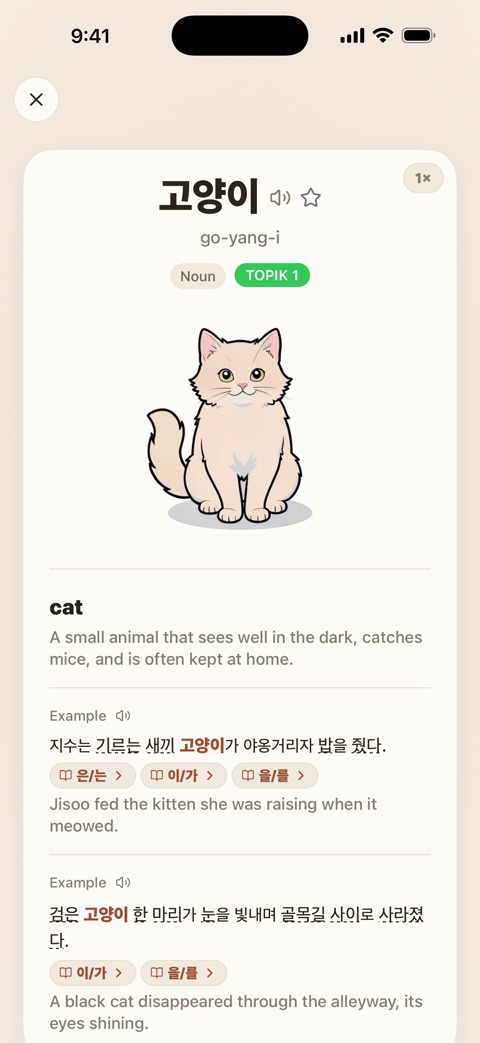
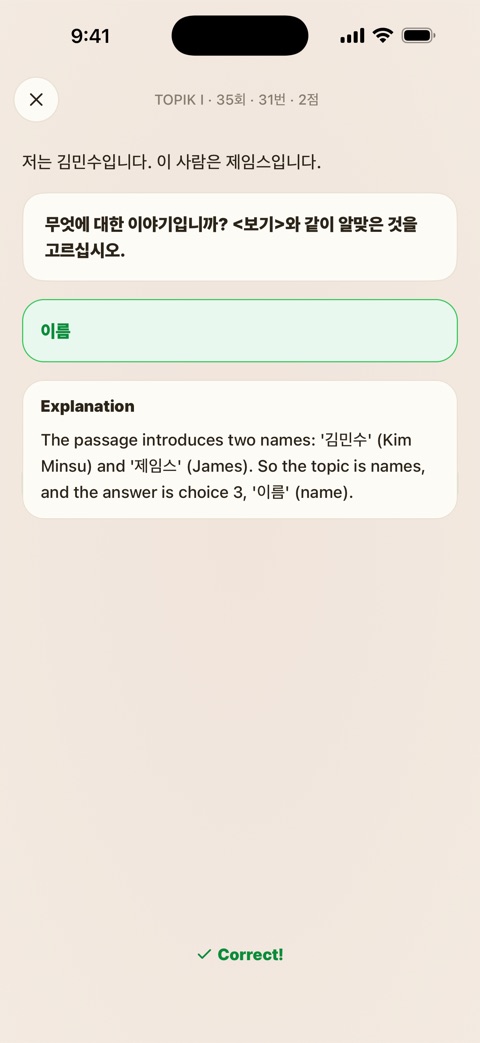
TOPIK Note includes 9,000+ words sorted by TOPIK level, based on the National Institute of Korean Language's official dictionary (krdict), with four quiz types, SRS review, and 870+ past-exam reading questions with English explanations. The frequency analysis in this article was built from the same data.
FAQ
QIs vocabulary alone enough to pass?
No — but vocabulary is the foundation for both reading and listening, and everything else builds on it. It deserves the highest priority.
QHow many new words per day?
20–40 new words plus SRS review is a sustainable pace. Three months of daily study beats last-minute cramming for retention.
QWhere can I get level-sorted word lists?
The National Institute of Korean Language publishes learner vocabulary lists. They're hard to study from as raw lists, though — pairing them with an app that pre-sorts by level and handles the SRS scheduling is the practical route.
QI can't read Hangul yet. Should I start with vocabulary?
Get comfortable with the alphabet first — a week or two with a Hangul primer app, then move to vocabulary.
Written by the TOPIK Note team (native Korean speakers).