
Asked for Directions in Korean but Could Not Follow the Answer?
You know how to ask 어디예요? (“Where is it?”), yet still do not know which way to go after hearing the answer. Directions combine places, numbers and movements. Instead of catching every word, separate where you act from what you do so you can ask a useful follow-up.
Practice showing a destination, picking out key information and confirming it. Every dialogue and diagram below is original learning material, not directions for a real station, route or building.
Confirm the destination together first
Get the person’s attention and make your destination clear.
Traveler: 실례합니다. 이 주소로 가려고 하는데, 어느 쪽으로 가면 될까요?
Other person: 아, 저쪽으로 가시면 돼요.
Traveler: 이 길로 쭉 가면 되나요?
Meaning: “Excuse me. I’m trying to get to this address. Which way should I go?” — “Oh, go that way.” — “Should I keep going along this road?”
Show the address when you say 이 주소 (“this address”). Similar place names and multiple branches can cause confusion, so have the address ready as well as the business name.
저쪽 (“that way”) depends on the direction the speaker points. If you missed the gesture, ask “어느 쪽이요?” (“Which way?”), or show a map and ask “지도에서 가리켜 주실 수 있어요?” (“Could you point it out on the map?”).
Hear a direction as an action
| Expression | Meaning here | A follow-up question |
|---|---|---|
| 쭉 가세요. / 직진하세요. | Keep going straight. | 이 길로 계속 가면 돼요? — Keep going on this road? |
| 왼쪽으로 가세요. | Go left. | 여기서 왼쪽이요? — Left here? |
| 오른쪽으로 도세요. | Turn right. | 이 모퉁이에서 오른쪽이요? — Right at this corner? |
| 길을 건너세요. | Cross to the other side. | 저 횡단보도로 건너면 되나요? — Use that crossing? |
| 건너편에 있어요. | It is on the other side. | 길 건너편에 있다는 말씀이세요? — Do you mean across the road? |
| 바로 옆에 있어요. | It is right next to the reference place. | 은행 바로 옆이요? — Right next to the bank? |
건너편에 있어요 describes the destination’s position. Do not treat it as an instruction to step into the road immediately; check where you can cross and the signals.
Remembering only 오른쪽 (“right”) may not be enough. Right from where you stand now differs from right after leaving a particular exit. Keep the reference point with the direction.
Catch the exit number and action order
Inside a fictional station:
Other person: 2번 출구로 나가서 오른쪽으로 가세요.
Traveler: 2번 출구로 나간 다음에 오른쪽으로 가면 되나요?
Other person: 네, 맞아요.
Meaning: “Go out through Exit 2, then go right.” — “Should I go right after leaving Exit 2?” — “Yes.” First leave through Exit 2, then go right. Turning right inside the station would change the instruction.
나가서 connects leaving with the next action. Similarly, “앞으로 가서 왼쪽으로 도세요” means “Go forward, then turn left.” If the turning point is missing, ask “어디에서 왼쪽으로 돌면 되나요?” (“Where should I turn left?”).
To check the number, ask “2번 출구 맞나요?” (“Is it Exit 2?”). 2번 is read 이번, but here it is an exit number, not 이번 as in “this trip.” Check the numeral on signs or the map too.
내리세요 and 갈아타세요 are different actions
Transport directions depend on verbs as much as place names.
Traveler: 어디에서 내리면 되나요?
Guide: 다음 정류장에서 내리세요.
“Where should I get off?” — “Get off at the next stop.” In this scene, leave the bus at the next stop. If you hear “다음 역에서 갈아타세요” (“Transfer at the next station”), you also need to change to another line or form of transport.
- 타다: board or ride a bus, train or other transport.
- 내리다: get off the vehicle you are riding.
- 갈아타다 / 환승하다: transfer to another vehicle or line.
“어디서 갈아타요?” (“Where do I transfer?”) may not provide everything you need. Ask “몇 호선으로 갈아타면 되나요?” (“Which line should I transfer to?”) and “어느 방면으로 타면 되나요?” (“Which direction should I take?”). Transfer procedures and fare conditions are not identical across cities and transport systems. Use current signs and the operator’s guidance for a real journey.
Split a long answer into place, number and action
Imagine hearing:
2번 출구로 나가세요. 출구에서 앞으로 가다가 은행 앞에서 오른쪽으로 도세요. 카페는 그 길 왼쪽에 있어요.
“Leave through Exit 2. Go forward from the exit, then turn right in front of the bank. The café is on the left along that road.”
| Reference point | Action or position |
|---|---|
| Exit 2 | Go outside. |
| From the exit to the bank | Go forward. |
| In front of the bank | Turn right. |
| The road after that turn | Look for the café on your left. |
The café is not on your left relative to where you originally stood. It is on the left after turning right at the bank. Confirm: “은행 앞에서 오른쪽으로 돌고, 그 길 왼쪽에 있는 카페죠?” (“Turn right in front of the bank, and it’s the café on the left along that road, right?”).
For a long explanation, ask “죄송하지만 한 단계씩 말씀해 주실 수 있어요?” (“Sorry, could you explain one step at a time?”). You can also check the route on a map before walking rather than trying to remember every sentence while moving.
Practice with a fictional route
This learning diagram has no real location. Up on the diagram is the direction you first walk after leaving the exit. Left and right follow the arrows.
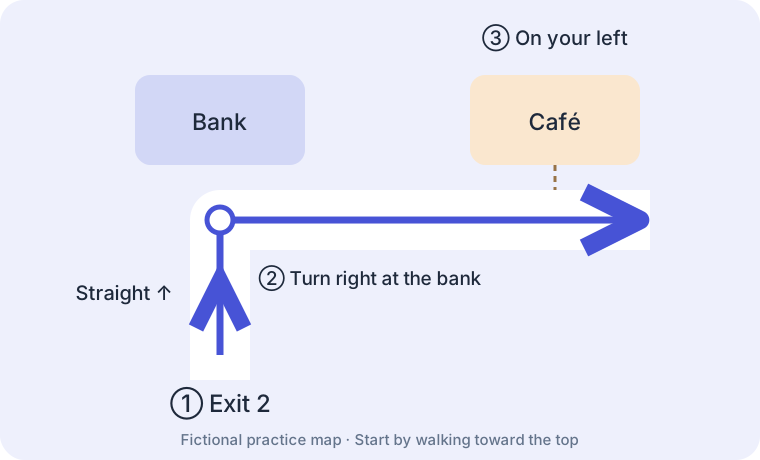
Move upward from Exit 2, then turn right in front of the bank. The café is on the left of a person walking rightward. The diagram does not specify crossing a road, so do not add that step.
Question 1: You hear “2번 출구로 나가서 은행 앞에서 오른쪽으로 도세요”. Can you turn right as soon as you leave the exit?
Answer: No. Go as far as the bank before turning in this example. Check with “은행 앞에서 오른쪽이요?” (“Right in front of the bank?”).
Question 2: In “카페는 그 길 왼쪽에 있어요”, when is “left” measured?
Answer: While walking along the road after turning right at the bank, not when you first leave the exit.
Question 3: What if you only missed the exit number?
Answer: Ask “몇 번 출구로 나가면 되나요?” (“Which exit should I take?”). Practice asking for the missing part instead of the entire explanation.
Common questions
QDo I need a long honorific sentence?
A short, polite start works: “실례합니다. 이곳은 어떻게 가요?” (“Excuse me. How do I get here?”). Show the destination, listen, then finish with 감사합니다 (“Thank you”).
QIs understanding left and right enough?
You also need the turning point. Ask “여기서 오른쪽인가요, 은행 앞에서 오른쪽인가요?” (“Right here, or right in front of the bank?”).
QCan I follow this route in a real station?
No. The station and route are invented for language practice. Check your real destination’s address, signs and current operator guidance. This example does not account for closed or inaccessible exits.
A small exercise for your next conversation
Repeat one place plus one action first: “2번 출구로 나가면 되나요?” (“Should I leave through Exit 2?”) or “은행 앞에서 돌면 되나요?” (“Should I turn in front of the bank?”). Short questions can still check the key information.
If you recognize words but miss the full meaning, read turning vocabulary into comprehension. The restaurant conversation guide practices separating people, quantities and places in staff questions. TOPIK Note is a Korean learning service; this article practices understanding Korean explanations rather than replacing real navigation.
References and real travel information
VISITKOREA’s transport guide separates transport between cities from transport within them. Consult the relevant section when preparing a trip. The directions and diagram here are original and do not quote a real station route. Source checked October 23, 2026.