Your First Korean Restaurant Visit: What Staff Ask and How to Respond
You have learned food names and 주세요 (“please give me…”), but then a staff member asks a question and the conversation stops. At a restaurant, you also need to discuss your group size, where you will eat, and how to order. Prepare the other person’s question and your answer as a pair, rather than only memorizing what you want to say.
Follow two diners from arrival to ordering and payment. These dialogues are original learning examples. Restaurants do not all ask the same questions or operate in the same way.
Arriving: 몇 분이세요? is not asking about minutes
You enter with a friend.
Staff: 안녕하세요. 몇 분이세요?
Customer: 두 명이에요.
Staff: 예약하셨어요?
Customer: 아니요. 예약은 안 했어요. 지금 자리 있나요?
Meaning: “Hello. How many people?” — “Two.” — “Do you have a reservation?” — “No, we haven’t reserved. Is there a table available now?”
Here, 분 is a respectful counter for people. The question is about how many people will eat, not how many minutes you will stay. Say 한 명이에요 for one person or 두 명이에요 for two. You do not need to copy the staff member’s respectful counter when counting a group that includes yourself.
If you booked, give the name: “네, 미나 이름으로 예약했어요” (“Yes, I booked under Mina”). Adding “지금 자리 있나요?” makes your request clear when you have not booked. Even if you see empty chairs, wait for guidance so you can find out whether they are reserved.
Ordering: make the food and quantity clear
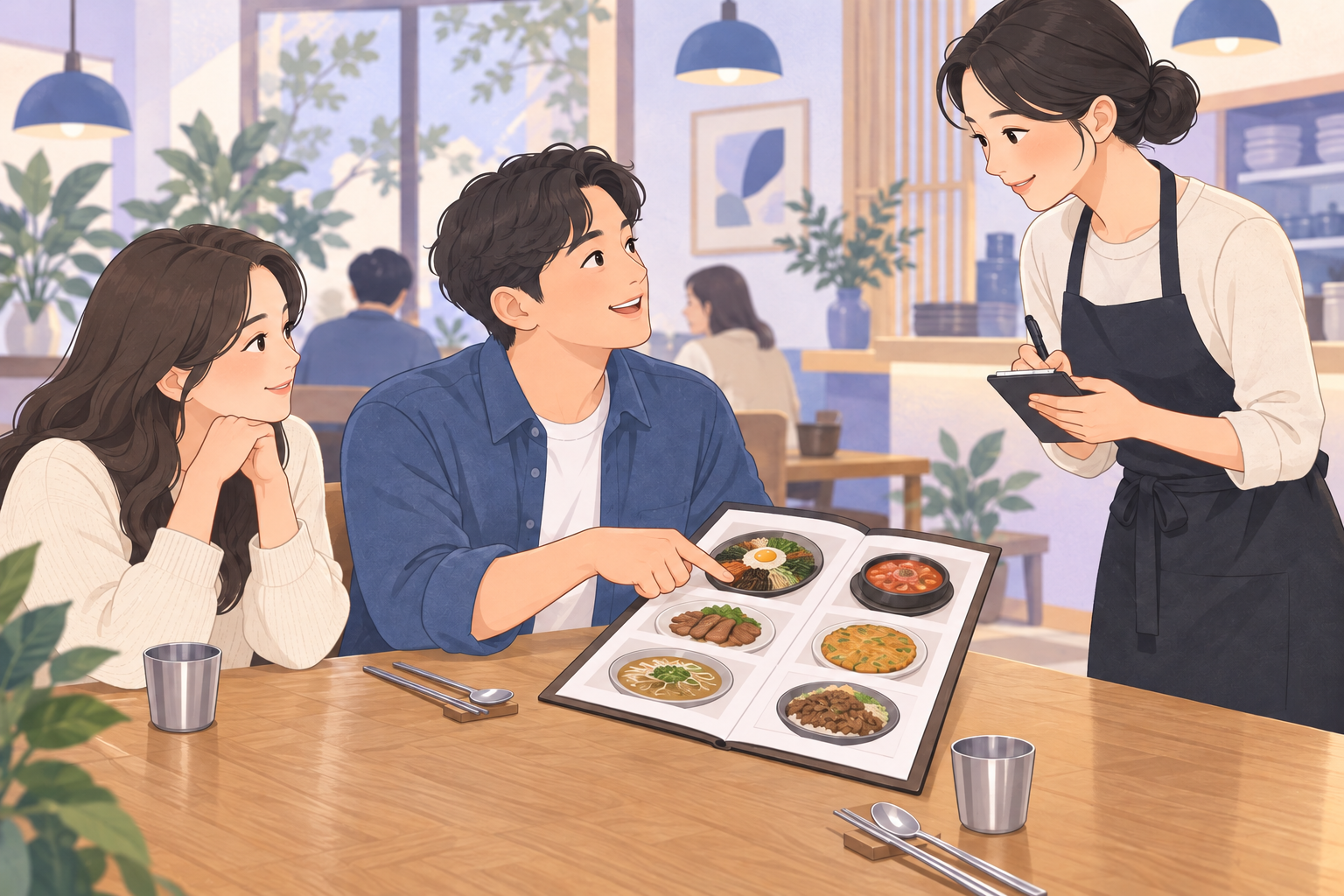
The customer points to bibimbap on the menu.
Customer: 저기요. 주문할게요.
Staff: 네, 말씀하세요.
Customer: 이 비빔밥 두 개 주세요.
Staff: 비빔밥 두 개 맞나요?
Customer: 네, 맞아요.
Meaning: “Excuse me. We’d like to order.” — “Yes, go ahead.” — “Two of this bibimbap, please.” — “Two bibimbaps, is that right?” — “Yes, that’s right.”
Repeating the food and number is an order check. Two diners do not necessarily want two identical dishes, so group size and order quantity are separate information. If the order is wrong, replace the incorrect part with what you actually want: “아니요, 비빔밥 한 개하고 국수 한 개요” (“No, one bibimbap and one noodle dish”).
On a menu, 인분 counts servings: 2인분 means two servings. 두 명 counts people; 2인분 describes food quantity. Check the menu or ask staff about any minimum order.
To ask about ingredients, say “이 음식에 고기가 들어가요?” (“Does this dish contain meat?”). To request a change, ask “고기를 빼고 만들 수 있나요?” (“Can you make it without meat?”). Asking does not mean the change is possible. Name any restricted ingredient clearly and check the reply. In particular, an allergy is not made safe simply by saying “빼 주세요” (“Please leave it out”).
When you hear 드시고 가세요?, answer where you want to eat
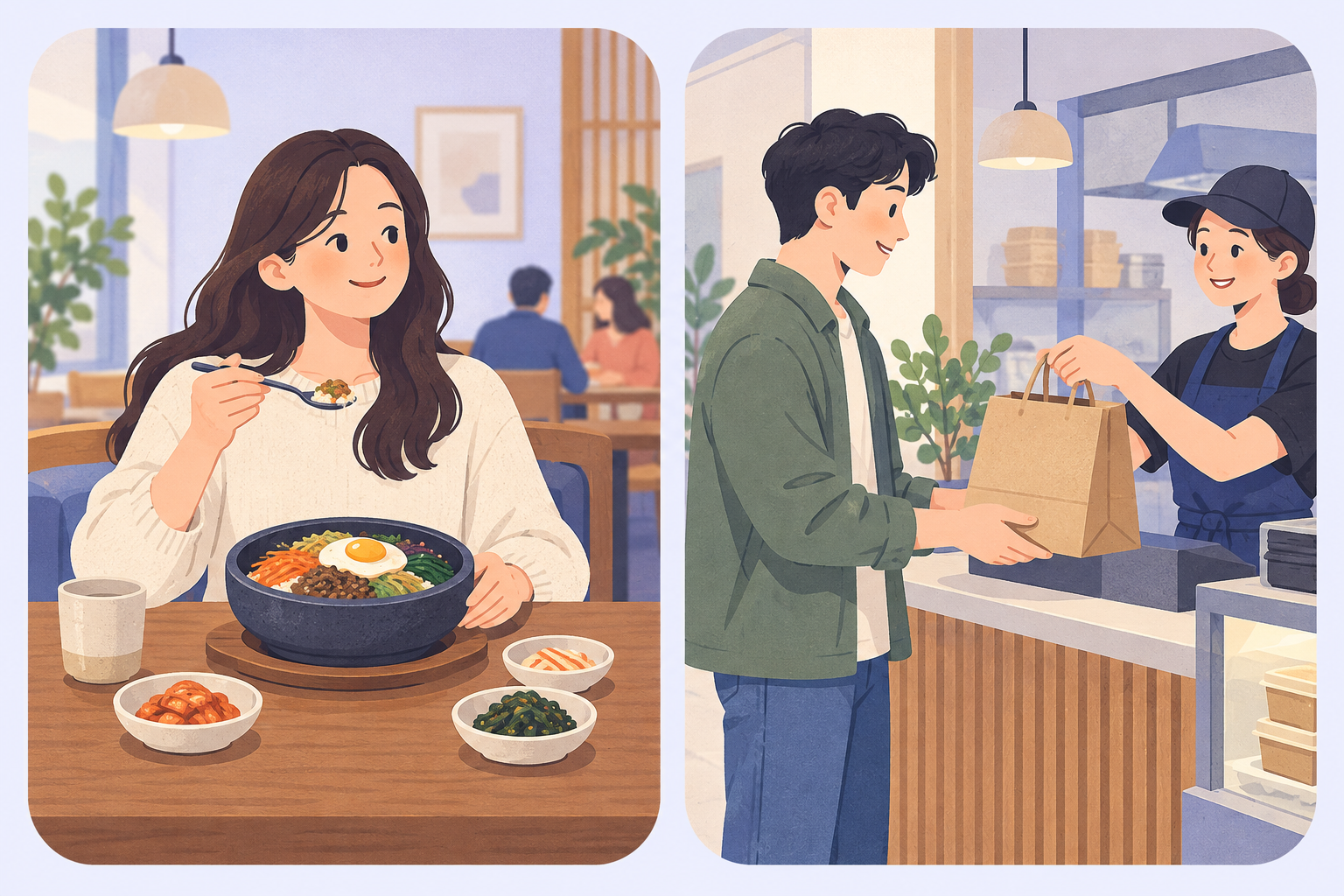
“여기서 먹을게요.” — “I’ll eat here.”
“포장해 주세요.” — “To take away, please.”
At a shop that also offers takeaway:
Staff: 드시고 가세요?
Customer: 네, 여기서 먹을게요.
Meaning: “Are you eating here?” — “Yes, I’ll eat here.” 드시다 is a respectful form of 먹다, “to eat.” To take the food away instead, say “포장해 주세요.”
The question can also be phrased differently:
Staff: 포장이세요?
Customer: 아니요, 여기서 먹을게요.
Meaning: “Is that to take away?” — “No, I’ll eat here.” Both customers are eating in, but one answers 네 and the other 아니요. If you miss the question, saying “여기서 먹을게요” or “포장해 주세요” is clearer than a bare “yes.”
Check how ordering and self-service work at that restaurant
Some places take orders through staff; others use a table screen or kiosk. “이걸로 주문하면 되나요?” means “Should I order using this?” If you are unsure whether payment went through after entering an order, ask “결제도 된 건가요?” (“Has it been paid for too?”).
If your table has a call button, check its label before using it. You can get a staff member’s attention with “저기요” (“Excuse me”) and then make your request. There is no need to assume one particular form of address is required everywhere.
“물은 셀프예요” means you help yourself to water. Ask “물은 어디에 있어요?” (“Where is the water?”) if necessary. Water being self-service does not mean you can help yourself to every side dish or other item. Read the instructions or ask what is included.
Paying: ask where and how separately
You have finished eating but do not know whether to wait for a bill or go to the counter.
Customer: 계산은 어디에서 하면 되나요?
Staff: 입구 쪽에서 해 주세요.
Customer: 네. 카드로 결제할 수 있나요?
Meaning: “Where should I pay?” — “Over by the entrance, please.” — “Okay. Can I pay by card?”
The first question checks where; the second checks how. A restaurant that takes payment with the order may say “먼저 결제해 주세요” (“Please pay first”). 먼저 indicates payment before receiving or eating the food.
Show a foreign-issued card and ask “이 카드로 결제할 수 있나요?” (“Can I pay with this card?”). That is a question about acceptance, not a promise that every card will work. If you cannot catch the amount, ask “금액을 보여 주실 수 있어요?” (“Could you show me the amount?”).
If you miss something, check one small part
To hear everything again, say “죄송하지만 한 번만 더 말씀해 주세요” (“Sorry, could you say that once more?”). For slower speech, try “조금 천천히 말씀해 주시겠어요?” (“Could you speak a little more slowly?”). If only one part is unclear, check just that part.
Staff: 주문은 저쪽 키오스크에서 해 주세요.
Customer: 저쪽에서 주문하면 되나요?
Staff: 네, 맞아요.
Meaning: “Please order at the kiosk over there.” — “Should I order over there?” — “Yes, that’s right.” The customer repeats the place and action, not the entire sentence. If needed, ask “화면에서 보여 주실 수 있어요?” (“Could you show me on the screen?”), or use a translation screen to check the meaning.
Review the question and answer together
| What you hear | What it checks | A possible reply |
|---|---|---|
| 몇 분이세요? | Group size | 두 명이에요. — Two people. |
| 예약하셨어요? | Reservation | 아니요. 지금 자리 있나요? — No. Is there a table now? |
| 두 개 맞나요? | Quantity | 네, 맞아요. / 아니요, 한 개요. — Yes. / No, one. |
| 드시고 가세요? | Eating here | 여기서 먹을게요. — I’ll eat here. |
| 포장이세요? | Takeaway | 네, 포장해 주세요. — Yes, to take away, please. |
| 먼저 결제해 주세요. | Payment order | 네. 어디에서 하면 되나요? — Okay. Where should I pay? |
Quick practice: You and a friend have no reservation. You want one bibimbap and one noodle dish, to eat in. Answer “몇 분이세요?”, “예약하셨어요?” and “포장이세요?”.
Possible answers are “두 명이에요”, “아니요. 지금 자리 있나요?” and “아니요, 여기서 먹을게요”. Answering only 네 to the last question could agree to takeaway. When ordering, give each dish and its quantity separately.
Common questions
QCan I order without speaking long sentences?
Start by pointing and saying “이거 한 개 주세요” (“One of this, please”). Still listen when staff confirm the dish and number, and correct anything different.
QCan I answer 먹어요 to 드시고 가세요?
It can convey meaning, but 여기서 먹을게요 states your location and intention more clearly. You do not need to use 드시다 about yourself just because the staff used it respectfully about you.
QIs there one payment rule for Korean restaurants?
This guide does not assume one. Follow that restaurant’s instructions and ask “계산은 어디에서 하면 되나요?” when unsure.
Practice for your next meal
Write down one new expression from your meal as a question paired with your reply. TOPIK Note is a Korean learning service. Continue with turning known vocabulary into reading comprehension, or practice identifying places and actions in Korean directions.
Language references
KBS WORLD’s restaurant lesson informed the restaurant expressions, and the National Institute of Korean Language’s explanation of 분 supports its respectful use for counting people. Outdated operational examples in older materials, such as smoking sections, were not used as current restaurant advice. All dialogues and exercises here are original. Sources checked October 23, 2026.
The illustrations were created with AI to explain learning situations. They are not photographs of a real restaurant.